
Interview and photos by Streets Dept Lead Contributor Eric Dale.
Since early 2022, a group of Philly street artists has been putting together a photo-focused zine that celebrates local, national, and international street artists. Priority Mag—or PMSLAPS if you’re cool—has embraced the do-it-without-waiting-for-approval attitude that’s prevalent in Philly. (Right? Am I off base to suggest that that feels like a Philadelphian hallmark?) With the help of contributors around the world, they document the latest street art and graffiti and interview artists.
The founder of Priority Mag is RoboQ4, a sticker and wheatpaste artist with dreams of using street art and its incredible community to do some good in the world. To that end, he incorporated the zine project as a 501(c)(3) nonprofit, United Street Art, in 2023. But Priority Mag is just the first step. Last year, he gave out 100 blackbooks, or sketchbooks used by street artists and graffiti writers, to kids in Philly, and he’d like to pursue funding that would allow him and his crew to create more art-focused programs like this.
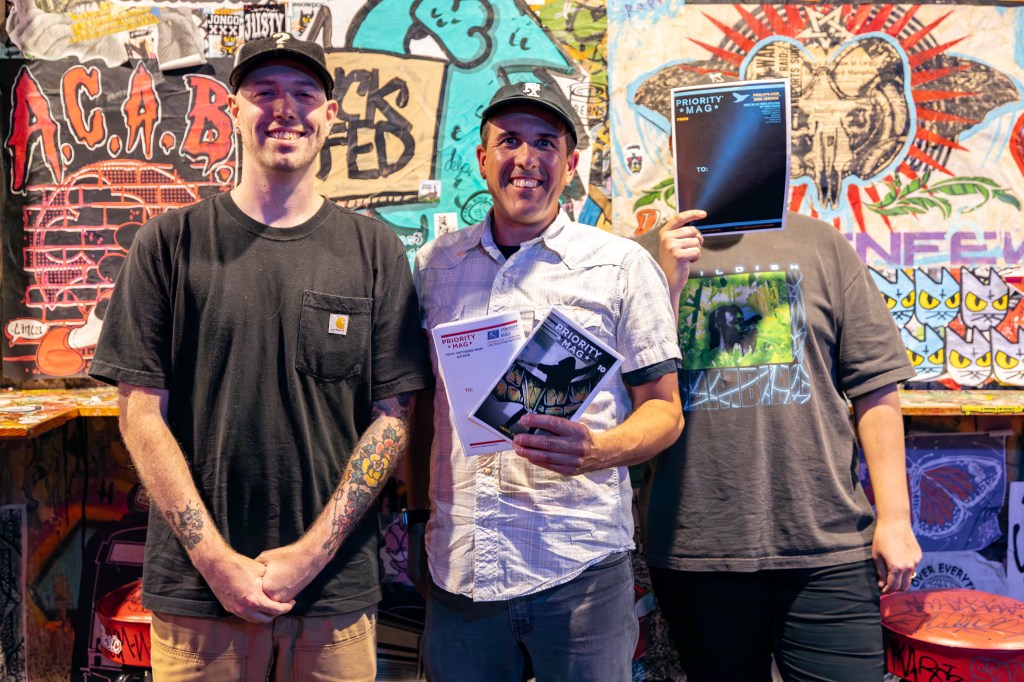
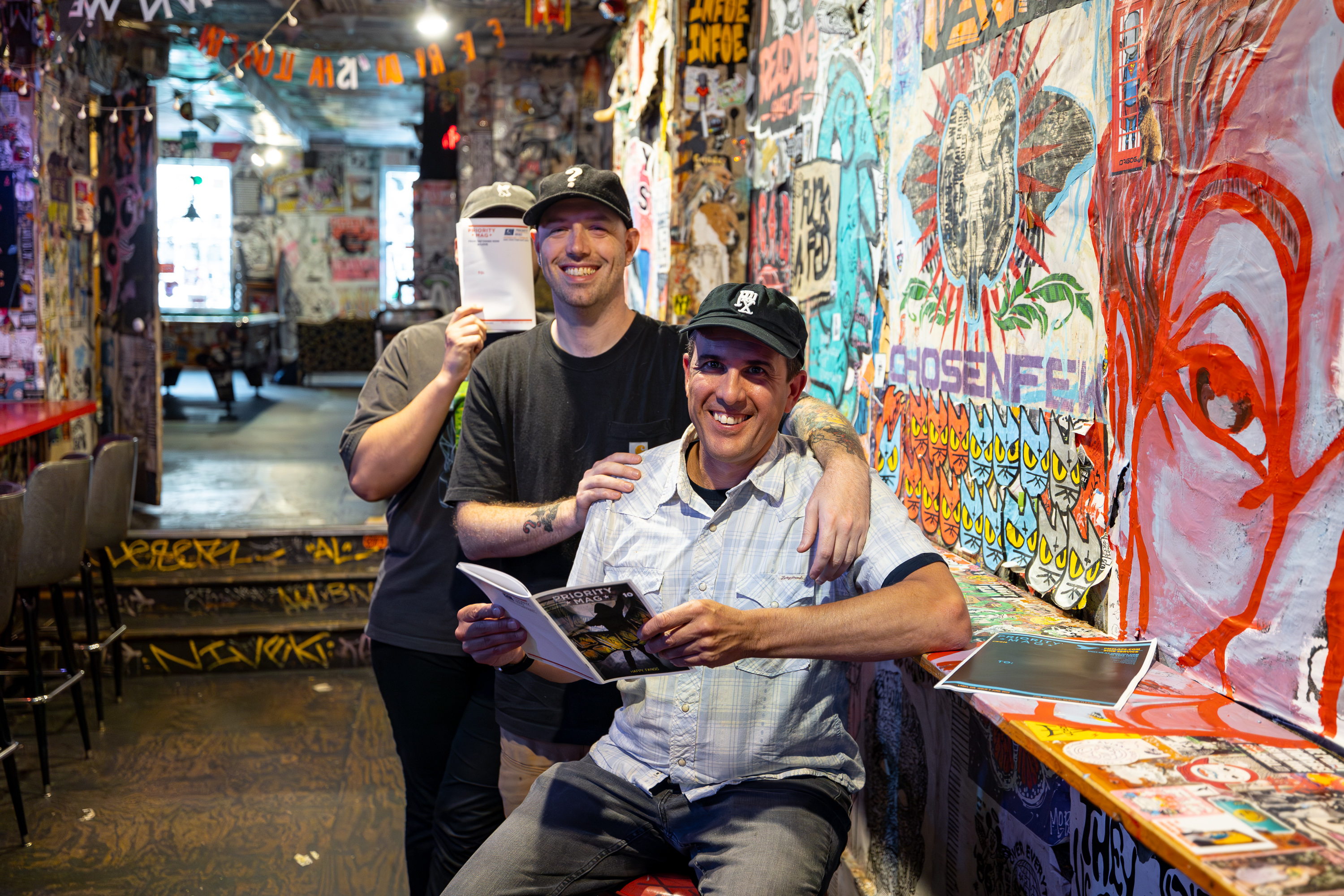
When I sat down with Robo at Tattooed Mom to talk about the zine, two other creatives joined him: The 666 Cat, who designs each issue, and a regular photography contributor who goes by the alias Phil Travel on Instagram.
Streets Dept’s Eric Dale: For starters, can each of you tell me a little about yourself?
RoboQ4: I’m Robo; I’ve been in the publishing industry for over 20 years, and I started Priority Magazine.
The 666 Cat: I’m The 666 Cat; I’m an illustrator, designer, artist, whatever you want to call it. Been in Philly for three years, kind of got involved thanks to Thirsty Walls and meeting Robo there. And then I think I started helping out a little bit on issue five.
Phil Travel: I’m Phil; I got involved in street art photography maybe three or four years ago. I’m not a native to Philly; I moved here about seven years ago. I would say that I got introduced to street art by osmosis, mostly due to Dobler. And yeah, Robo was gracious enough to invite me into his project to do the “Pier Review.” So we’re just covering—either every other issue or every quarter issue—Graffiti Pier.
SD: Robo, why did you start Priority Mag?
R: I started Priority Mag as a way to create a community and build a network—a mini publishing company—to promote street artists of all kind and to raise awareness of some of the things that we want. Our mission [is to] break down gray and beige walls and to chip away at the beef culture, and to just get more people involved.
SD: Cool. So what is each of your roles in Priority Mag?
R: My role is mainly organizing chaos—herding cats. You know, coming up with the artist to interview, coming up with the people to write submissions, managing the submission forms, and just basically the general printing and distribution. And one thing I’d like to say is that we’re kind of organic growth here. We haven’t really done too much in social media, algorithms, AI, or anything like that to advertise or promote PMSLAPS. So it’s really word of mouth, and we’re slowly getting more into some digital distribution, maybe next year.
666: I don’t have a fixed role; I think it changes with every issue. But I guess I got started kind of helping out with the general layout of the zine itself.
R: You could say “Lead Designer.”
666: Yeah, Lead Designer—I would say “Creative Director,” but yeah—I think that’s kind of how I got involved. Once we changed to the new format that we’ve been using for the last two years, I helped set that up and clean it up and streamline it, and then figuring out what are the things that we can repeat easily and not make so much work for ourselves. And then overall, I think I’m just kind of a naysayer, so I’m cutting out bad ideas. I’m here calling out Robo for stretching photos.
R: I’ll give you a good example of his creative input. We were going to do a double issue. It was going to be half Now I Wanna Sniff Some Glue and half Issue 10. And he said nix it. We need to make a special issue just for Sniff Glue and keep Issue 10 Issue 10. And I followed it.
PT: Like I said, Robo was gracious enough to invite me to the project, to cover the Pier and use my photos as he sees fit for the mag.
R: I’ve been following Phil for a long time and noticed that any time someone would go to Graffiti Pier and do a new work, within 6 to 18 hours, Phil was posting a photo of it. I was like wow, this guy’s got all the coverage. We need him as part of our zine; as part of our mission.
SD: Why was joining Priority Mag as a contributor exciting, Phil?
PT: One, I really appreciate Robo’s dedication to the scene itself. I feel like he really cares about the community. And I just wanted to be a part of that through this project. And then I really like the idea of having a singular vantage point of covering the Pier—obviously “OCD” is a very overused term, but I’m very particular when it comes to the way things look and just general themes, so that really made sense to me—just covering the Pier. And I’m a ten-minute drive from there, so having the ability to go over there and having the built-in excuse of working for the magazine was nice.

SD: Okay, cool. So what is the design process like? How do you take it from a collection of stuff to a finished product?
666: Honestly, the bulk of the work is before the actual design. Once we have the photos uploaded to the drive; we know what we’re picking through; we have all the interviews collected from the correspondents; I think it’s actually pretty quick at this point. Especially since we’ve had templates for the last two years. It’s just kind of like do we have too much shit? Do we need to cut down and spread this onto the next issue? What’s the tolerance of the printer? Can we go 40 pages? Can we go 44 pages? But yeah, otherwise, it’s pretty simple.
I’m very picky about not retouching photos, because we get so many submissions. [Anything that] we get [from] people like Phil—you know it’s ready to go. But a lot of people that send stuff in, it’s like okay, you sent a JPEG that is 12 kilobytes. A Nokia phone can’t open this thing. So yeah, a lot of it’s just sorting through that stuff, finding the good stuff that we can use and just plugging it in. And Robo does a lot of it too.
I feel like it’s always a last-minute thing. It’s like okay, what’s the next event at Tattooed Mom? We need to have it ready to go. So I’d say within a couple days, we got it laid out, and then we usually print a couple, find some mistakes, and then fix those and then do it again.
SD: For all of you, what’s been the most rewarding part of putting together Priority Mag?
R: My rewarding piece is seeing all the submissions from random people all over the world. We’re getting stuff from Philly, from Australia, from Asia, from all over. So that’s really nice—to see the submissions come in.
666: It’s nice that it exists and that people are excited to pick it up every time that we come out with a new issue. But I think something that Robo really hasn’t mentioned yet that’s cool is that we’ve been successful with this for the last couple of years—and now Sticker Movie, in the last year, for their promotion, has been hitting up Robo because they like the zine and how it’s built up and they kind of mimic that for their different premieres that they’ve been having around the country and the world. So I guess that’s pretty rewarding, the fact that another organization or entity of artists was like oh, that’s a cool thing; let’s get them to do it for us.
R: And that speaks to how we want it to be a publishing go-to. You know, not just a Philly zine, but hey, I want to make a zine—hit us up and we’ll help you put it together.
PT: I mean, selfishly, I do love seeing my photos in print, so that’s always nice! But I think the grander vision is great. Robo, 666, and everybody else involved are really trying to foster a community, and you can see that through their successful partnering with projects like Sticker Movie. And it feels nice to play a small part in that really large scene. It’s cool to see and be around people who want the best for it, and kind of foster the growth of that community as well.
SD: So the issues of Priority Mag that I’ve read have felt kind of insider-y. Is that an intentional appeal to artists, or do you want this to be more wide-reaching?
666: I don’t think we’ve ever really thought it through, per se. It’s not like we have a specific editor voice that we want for the articles. They’re all submitted mostly by other artists or people that follow the scene, and the interviews are usually by artists as well. So I think that’s just the nature of it. That’s the way we speak, and that’s kind of our general public.
But I do think young people, even if they’re not directly involved in street art—especially if they live in major cities like Philadelphia; New York—they kind of understand it; they kind of know the ecosystem. It’s likely that they have a friend that’s an artist that’s involved in it. I don’t know, it’s just surprised me how many people that don’t do [street art] know about, like, sticker culture and whatnot and look out for it. I would say it’s the same for graff and wheatpaste and whatnot.
I would just say we did it inadvertently, but I think speaking the language of the artist is probably good, because the reader will pick up on it, and they’re just getting the authentic explanation of things.
SD: You’re just reflecting the culture as it is.
666: Yeah, it’s definitely not didactic at all, but it’s also not gatekeepy. Like, if anybody is using slang or anything, I don’t think they’re doing it to hide what the hell we’re doing. So that’s kind of the way it is.
R: To add onto that, after issues one and two, I quickly realized that we have to expand way beyond Philly, because the first two issues were very Philly focused. Then we reached out to Fuck A Fuckin Job and he was our foreign correspondent interviewer. So, we knew that we had to get international interviews to expand it out. And the language of the interviews is, like you said, for artists, by artists. But we’re slowly trying to make it go a little more mainstream.
666: Yeah, and I think that also lets people know that if they read it and they’re from another city, they feel like they could participate and submit because it’s not just a Philly thing. So when they see other people, they’re like oh, I have a chance; I could do something; I could send something. I think that’s just going to grow our audience.
SD: I can send a 12 kilobyte JPEG.
666: Exactly. And they do!

SD: Why is Priority Mag organized as a nonprofit?
R: I am big into legacy, so I really want to leave something when I leave this Earth. I want PMSLAPS to be still going. I really want to see this grow into a full, bigger nonprofit, where we can go after some of these government grants and create more programs. Do programs that help youth and afflicted people, and just really have a mission behind us.
One of our other missions is: street art is our therapy. And the more we get into going on routes and doing things with different groups, there’s some funding involved and it can help PMSLAPS grow bigger than the ragtag group that we are now, into a more fully-fledged nonprofit organization.
SD: If you could crystallize it in a few sentences, what is your mission?
R: Our mission is creative expression in the streets, help underprivileged artists by providing them with resources—financial resources as well as artistic resources. We did a program last year where we gave away 100 free blackbooks. We purchased the sketchbooks, we gave them out to 100 artists, and we see how that can grow into a bigger program with more funding, where we can do an after school project; we can do a teenage drawing group. Or we can do something that would help people with some of their struggles.
SD: Cool. So you released your 10th issue in August. Can you tell me a little about it? What makes it special?
R: This goes back to the issue that we wanted to do as a double issue. So, Issue 10 was really something that we had pretty much already baked. It’s all focused on Portland artists: Happy Fangs, Sneezington Shitz, and the My Father’s Place drawing group. And it’s just a great issue, chock full. This is our text-heaviest issue to date. Three interviews, 30 rapid fire interviews, great photos, and it just summarizes pretty much the whole Portland art scene.
666: I feel like that’s the first/biggest out-of-Philly collection that we’ve done of people in one issue.
SD: How does one submit their work to Priority Mag?
R: We have three different ways you can do it. You can DM us on Instagram, you can scan a QR code that’s in our zine, or you can email us at stickers [at] pmslaps [dot] com.
SD: And it sounds like you take photos, interviews, writings… What are the limits on it?
R: There are no limits—
666: Well, there are actually some limits.
R: See, this is the Creative Director coming in!
666: Photos: minimum one megabyte. It has to be minimum one megabyte. I don’t even care about the size. Decent photos is always appreciated—the better lit they are, and the better quality always helps out a lot.
If somebody does submit and they have more than a couple examples, that’s great. If there’s somebody that does stickers, wheatpaste, and graffiti, it’s nice when people send us like the whole array of what they do. I think that makes it easier for them to actually get into the zine, because if you have a full body of work, it’s easier to set aside a page for you.
And then when it comes to articles, we’ll take anything, but, you know, it doesn’t have to be an extremely long interview. I’d say something in between eight or ten questions. Something that’s probably max two spreads is probably what we’re looking for, because clearly the interview side is important, but we’re always going to put the photos in there too. So yeah, something reasonable.
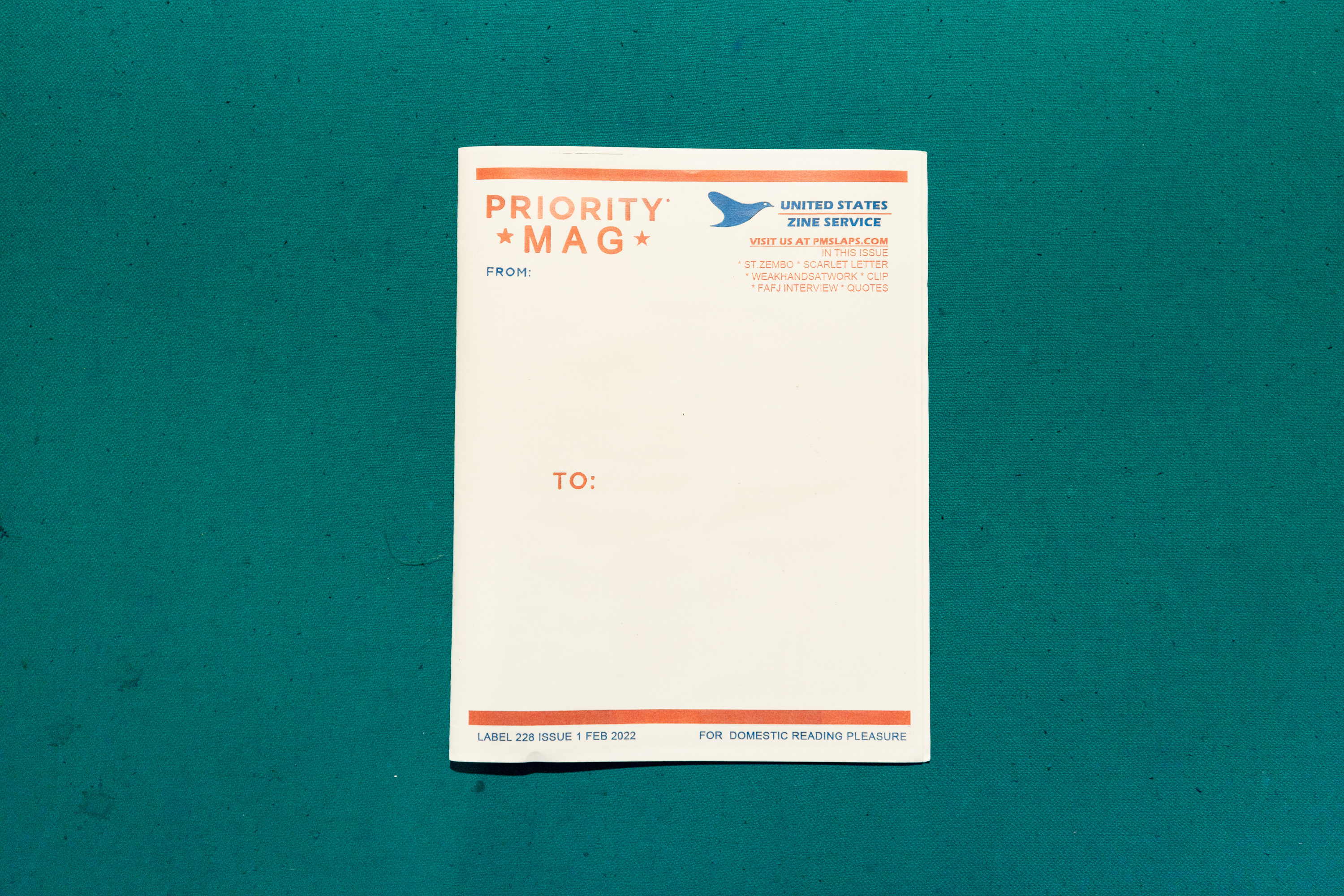
SD: Okay. And how does one get their hands on a copy?
R: Well, big shout out to South Street Art Mart in Philly. They stock our zines, so you can go down there and support a small business and pick up our zines there. We usually drop off the latest issues right after they’re printed. They have a lot of our back issues. You can go to pmslaps.com and hit our website and order directly from our website. Or you can lurk around Tattooed Mom, and maybe you’ll find one on a Thirsty Walls night, or you might find one down on the table. We might do some random drops that you can pick up. Our issues are $5 apiece.
666: And also on the website, you can subscribe, so you can find it in your mailbox if you want to.
R: Yes, that’s the big thing, subscribers. We want more subscribers. Subscribing is very beneficial to you because you get it in your mailbox, we throw some stickers in with it, and it’s a nice little surprise when you come home after a long day to see a zine with stickers in your mailbox!
666: Yeah, and your subscription always includes the four quarterly ones that we do, and then there’s always a fifth every year that we do that’s like a special edition.
R: Last year was the coloring book.
666: And then if you’ve missed any in the past, online, you can order all the back orders and we have different packages for those.

SD: Real quick, I’d just like to acknowledge and thank Tattooed Mom for allowing us to do this interview upstairs during off hours. And I know that each of you has a deep relationship with this space, so can you give me one sentence that sums up your thoughts about TMoms?
666: Best bar in Philly.
R: The staff—the whole team at Tattooed Mom—is amazing. They’re quick to pour a drink; they’re quick to get your food to you; and they’re so great on those busy nights. It’s just a pleasure seeing everyone’s smile on their face here.
PT: I feel like a big thing coming from me has been fostering community tonight, and I feel like there’s no better place than TMoms at doing that, whether it be for the street art community, or poetry nights, or once-a-month punk rock karaoke. I just feel like they do such a great job of fostering community in and outside of the scene that we are all a part of.
SD: Anything else that you guys want to share?
R: Yeah, I would like to give a special kudos to Gloopy Goblin, who is also a big photo contributor to the zine. I will get a spontaneous text message with pics from their travels to NYC, Portland, Seattle—Gloopy is a big contributor, brainstormer, and promoter of our zine. I would like to give a final shout out here for some of the people that helped get Priority Mag off the ground in our early days. One, going back to TMoms, is Robert, the owner. He was a very big supporter, and contributor, and sponsor for PMSLAPS. And then the rest of the Shaky Hands Crew: Banjax, Praise Dobler, Spud, Lami, Misprint, FAFJ, Anti Flower Show Movement—were the original group; the founders.
 Streets Dept
Leave a reply to Eventos del Mes de la Historia Negra; Víctimas de patinadores locales en choque; Escuelas de Filadelfia progresando – Spanish News Cancel reply